
Fighting Back: What Actually Works When a Threat Breaches the Room
No one wants to imagine being forced to defend themselves from a violent attacker. In an ideal world, evacuation or sheltering would always keep danger at a distance. But there are moments when a threat breaches the room and the only remaining option is to fight. In these situations, hesitation is dangerous—and strategy matters.
Fighting back isn’t about heroics. It's about survival, protecting others, and using simple, effective techniques that work under real-world conditions. When people understand how to disrupt an attacker, they gain the power to save lives, even in the most extreme circumstances.
The Goal: Control the Weapon, Control the Situation
When an attacker enters a room, the weapon is almost always the first thing through the doorway. That single detail provides a crucial advantage: the weapon—and the attacker’s arms—can be intercepted before the rest of the body enters.
Controlling the weapon isn’t complicated. It’s physical, instinctive, and relies on leverage rather than strength.
What Actually Works in a Real Fight
1. Wrap the Weapon or Arms Immediately
The first person closest to the doorway has the most critical job: engage the weapon instantly.
The proper motion is a tight, wrapping, hugging grip around:
the weapon itself, or
the attacker’s arms
The goal is to trap the weapon and limit its movement. This reduces the attacker’s ability to aim, strike, or use full force.
This grip is not gentle—it should be firm, tight, and committed.
2. Go Limp at the Knees to Bring the Attacker Down
Trying to wrestle an attacker upright is difficult and dangerous. Instead, the fastest way to pull them off balance is to drop your weight.
Going limp at the knees:
drags the attacker downward
removes their stability
reduces their power
makes it harder for them to fight or maneuver
Body weight is a powerful force—even the strongest person will struggle to lift another adult’s full weight with just their arms.
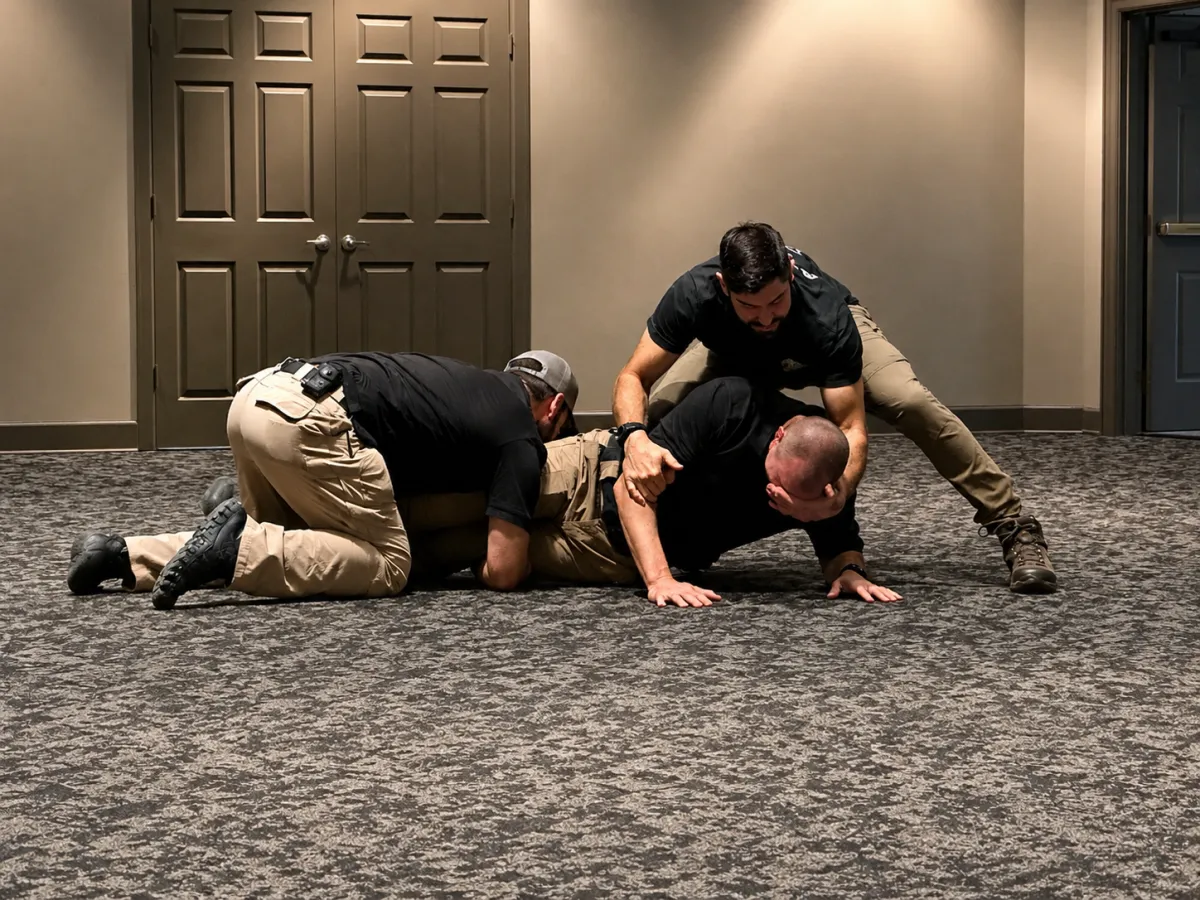
3. Work as a Group to Overwhelm the Attacker
Once the first defender wraps the weapon, the others take immediate action. Fighting back is not a solo effort—it is a coordinated group response.
Effective group actions include:
tackling the attacker’s legs
driving them to the ground
piling onto the torso and limbs
squeezing tightly to restrict movement
The goal is not to strike or harm, but to immobilize.
When multiple people apply pressure from different angles, the attacker becomes overwhelmed quickly.
4. Stay Off the Line of Fire
Even while fighting, positioning matters. The safest areas are to the sides of the weapon, not directly in front of it.
Being off the line of fire means:
limiting the attacker’s ability to aim
protecting vital areas of the body
reducing accidental exposure to the weapon
This principle applies the moment contact is made and throughout the struggle.
5. Commit Fully—Hesitation Creates Danger
Half-measures are dangerous. If fighting is necessary, it must be done with full commitment. This isn’t about aggression—it’s about survival.
Full commitment:
reduces the attacker’s options
increases the speed of control
boosts group morale and confidence
shortens the duration of the encounter
The faster the attacker is overwhelmed, the safer everyone becomes.
What Doesn’t Work (And Why)
Not all instinctive reactions help in real emergencies. Some actions can make the situation significantly worse.
1. Standing Back and Throwing Objects
Projectiles may distract but rarely disable an attacker—and they waste valuable time.
2. Trying to Grab the Weapon Alone
Isolated attempts are far less effective than coordinated, multi-person engagement.
3. Staying Far From the Door
Distance removes your ability to influence the attacker before they fully enter the room.
4. Attempting Complex Moves
High-stress situations demand simple, gross-motor actions—not fine motor skills or complicated techniques.
These ineffective strategies prolong danger rather than reduce it.
Why These Techniques Work
The methods described here succeed because they rely on:
leverage over strength
group coordination rather than individual effort
simple motions that work under stress
disrupting the weapon’s control
overwhelming the attacker quickly
They do not require specialized martial arts training or athletic ability. They require proximity, teamwork, and decisive action.
Key Takeaways
If fighting becomes necessary, the goal is to control the weapon.
Wrapping the weapon and dropping your weight are highly effective techniques.
Group overwhelm is far more reliable than individual action.
Staying off the line of fire reduces risk.
Commitment and coordination save lives in close-quarters emergencies.
Fighting an active threat is the last resort—but when it becomes unavoidable, knowing what actually works can make all the difference. Simple, coordinated techniques give ordinary people the power to stop an attacker and protect others.
Preparation isn’t about fear—it’s about readiness. Understanding how to take action when escape and sheltering are no longer possible can save lives and give communities the confidence they need to face the unthinkable.


